- All
- Product Name
- Product Keyword
- Product Model
- Product Summary
- Product Description
- Multi Field Search
Views: 0 Author: Site Editor Publish Time: 2026-08-10 Origin: Site


Steel flat bars are a foundational component in modern engineering, construction, and manufacturing. Valued for their versatility, geometric predictability, and structural reliability, these solid, rectangular steel sections are indispensable across heavy industry. From reinforcing massive bridge decks to acting as the raw material for precision-machined brackets, the flat bar is a universal building block.
However, while these materials are ubiquitous, specifying them incorrectly carries significant risk. Selecting the wrong grade, choosing an inappropriate processing method, or misunderstanding the difference between true and sheared edges can lead to structural failures, excessive machining costs, rapid tool wear, or severe project delays. Engineers and fabricators must match the material's mechanical properties to the exact demands of the application.
This technical evaluation guide explores the common applications of steel flat bars, compares material processing types, and establishes strict procurement criteria. By understanding the nuances of manufacturing methods and alloy grades, you can optimize structural integrity and streamline fabrication for your specific project requirements.
Application Versatility: Steel flat bars are primarily utilized for structural support, base plates, custom fabrication, and heavy machinery frameworks due to their high strength-to-thickness ratio.
Processing Dictates Function: The choice between a hot rolled flat bar and a cold finished alternative fundamentally alters cost, surface finish, and dimensional tolerances.
True vs. Sheared Flat Bars: Specifiers must understand the difference between true (mill-rolled edges) and sheared (slit-and-edged coil) flat bars to prevent edge cracking and dimensional instability during fabrication.
Evaluation Metrics: Procurement decisions must weigh yield strength, weldability, and machinability against the specific environmental and load-bearing demands of the end-use application.
Risk Mitigation: Anticipating residual stress, warpage during welding, and corrosion risks is critical for successful implementation and long-term structural integrity.
A steel flat bar is defined by its rectangular cross-section, characterized by a specific thickness-to-width ratio. Unlike sheet metal, which is typically under 3mm thick and supplied in wide coils, or plate steel, which covers large surface areas, a flat bar is narrow and thick. Standard widths generally range from 12mm to 300mm, with thicknesses varying from 3mm up to 50mm or more. This geometry provides substantial rigidity along the longitudinal axis while allowing for straightforward welding, drilling, and bending operations. The concentrated mass makes it ideal for localized load distribution.
When you order a Flat Bar, you are getting a product designed for structural integrity. The thickness ensures it won't buckle under compressive loads, while the width provides a stable surface for bolting or welding. In the field, we rely on these dimensions to calculate load paths and ensure connections meet engineering specifications.
The method used to manufacture a flat bar directly impacts its internal stress profile and edge condition. Specifiers must distinguish between two primary production techniques to avoid fabrication issues down the line.
True Flat Bar: This material is hot-rolled to its finished size at the mill. The process yields clean, slightly rounded mill edges and maintains minimal internal stress. True flat bars are highly stable during extensive machining or thermal cutting. When you run a plasma torch down a true flat bar, it stays straight.
Sheared and Edged (Slit Coil): These bars are cut from wide steel coils or plates. The slitting process introduces significant mechanical force, followed by edge rolling to remove burrs. This method leaves higher residual stresses within the steel. When subjected to welding heat or asymmetrical machining, sheared and edged bars are prone to warping and edge-hardening. If you try to mill a sheared edge, expect your tool life to drop significantly.
The mechanical capabilities of a flat bar are dictated by its chemical composition. Carbon steel grades are the most prevalent, offering a balance of strength, ductility, and weldability. ASTM A36 is the industry standard for general structural applications, providing a minimum yield strength of 36,000 psi. For high-stress environments, ASTM A572 Grade 50 offers a higher yield strength (50,000 psi) with excellent load-bearing capacity. Mild carbon grades like 1018 and 1045 are frequently specified when machinability and surface hardening are required for mechanical components.
Steel Grade | Yield Strength (Min) | Tensile Strength | Primary Application | Weldability |
|---|---|---|---|---|
ASTM A36 | 36,000 psi | 58,000 - 80,000 psi | General structural framing, brackets | Excellent |
ASTM A572 Grade 50 | 50,000 psi | 65,000 psi | Heavy load-bearing, bridges, infrastructure | Good (may require pre-heat) |
AISI 1018 | 54,000 psi (Cold Drawn) | 64,000 psi | Machined parts, pins, shafts | Excellent |
AISI 1045 | 77,000 psi (Cold Drawn) | 91,000 psi | Gears, wear plates, high-strength components | Fair (requires pre/post-heat) |
In practice, the flat bar functions primarily as a structural connector and reinforcing element. It spans gaps, braces frameworks, and anchors heavier structural shapes like I-beams and HSS (Hollow Structural Sections). Beyond construction, it serves as the raw billet for machined components, where fabricators cut, drill, and mill the bar into custom hardware, flanges, and machinery parts.
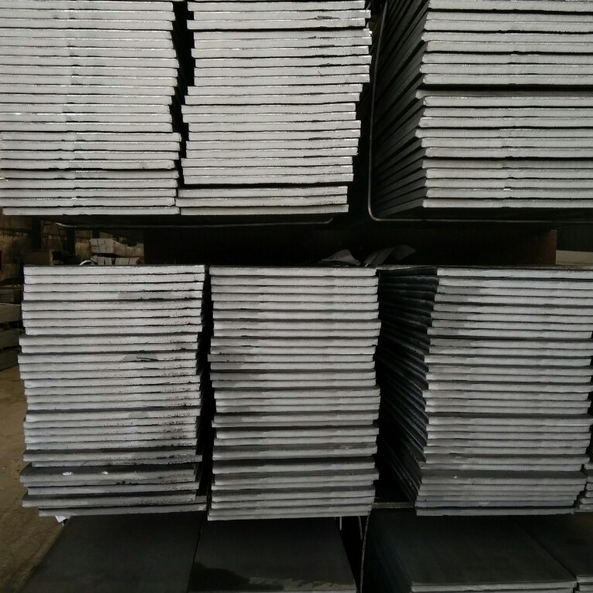
In commercial and industrial construction, flat bars are essential for cross-bracing and truss fabrication. When bolted or welded diagonally across structural bays, they provide critical lateral stability, preventing wind or seismic loads from racking the building frame. Their high strength-to-thickness ratio allows them to distribute heavy loads efficiently without adding excessive bulk to the architectural footprint. Furthermore, integrating flat bars into larger assemblies prevents torsional twisting in long-span beams.
On the job site, you'll see flat bars used as X-bracing between columns. We tension these bars to ensure the building skeleton remains rigid before the cladding goes up. The predictability of the steel's yield point allows structural engineers to calculate exactly how much wind shear the frame can handle.
Connecting vertical columns to concrete foundations requires robust base plates. Flat bars, cut to length and drilled for anchor bolts, serve this purpose by spreading the column's compressive load over a wider area of the concrete footing. In beam-to-beam connections, flat bars act as splice plates, bridging the joint to maintain structural continuity. As gusset plates, they reinforce angular connections in trusses, transferring shear and axial forces safely between intersecting members. Thickness and yield strength are the primary calculations for these load-bearing nodes.
Base Plates: Cut from thick flat bar stock, drilled for anchor bolts, and welded to the bottom of columns.
Splice Plates: Bolted across the web or flanges of two adjoining beams to transfer bending moments.
Gusset Plates: Welded at the intersection of truss members to handle complex multi-directional loads.
Heavy-duty flat bars frequently function as structural lintels over doors, windows, and pathways in masonry construction. Placed horizontally across the opening, the bar supports the weight of the brick or block wall above. The thickness of the bar must be precisely calculated to limit deflection under the dead load of the masonry, ensuring the building facade remains crack-free over decades of settlement.
Civil engineering projects demand materials capable of withstanding dynamic loads and harsh environments. Flat bars reinforce bridge decking, secure guardrail posts, and act as structural ties in retaining walls. They are also integral to expansion joint assemblies, allowing concrete slabs to expand and contract with temperature fluctuations. High-yield steel grades, particularly ASTM A572 Grade 50, are mandatory in these applications to resist the cyclical fatigue caused by heavy vehicular traffic.
The industrial manufacturing sector relies on flat bars to construct the chassis and moving components of heavy machinery. Agricultural equipment, mining conveyors, and material handling systems utilize thick carbon steel bars for their exceptional wear resistance and ability to withstand cyclical loading. Fabricators weld these bars into rigid frames that support engines, hydraulic cylinders, and heavy payloads, ensuring the equipment operates reliably in abrasive environments.
Transportation manufacturing requires a strict balance between structural rigidity and weight management. Flat bars are extensively used in trailer manufacturing, truck bed framing, and railway car assemblies. They reinforce high-stress zones, such as suspension mounting points and hitch receivers. Custom chassis fabricators utilize them to create cross-members that resist torsional flex during transit, ensuring vehicle stability under heavy cargo loads.
The rapid expansion of renewable energy relies heavily on standardized steel components. Solar panel racking assemblies utilize flat bars as support brackets, securing the photovoltaic arrays to ground mounts or rooftop structures. In wind energy, thick flat bars reinforce the internal platforms and ladder systems within the turbine towers. Additionally, galvanized flat bars are frequently buried as electrical grounding grids to safely dissipate lightning strikes and electrical faults.
At the component level, flat bars are the starting material for countless bespoke hardware pieces. Stamping presses, CNC plasma cutters, and heavy-duty drills transform raw bars into heavy-duty hinges, pipe hangers, and industrial mounting brackets. The consistent geometry of the bar allows for rapid, repeatable fabrication, minimizing material waste during the production of specialized fasteners.
Modern industrial architecture frequently leaves structural steel exposed as a design feature. Flat bars are prominent in this aesthetic, utilized for stair stringers, canopy supports, and intricate facade framing. The clean, straight lines of a true mill-edge bar provide a minimalist, robust appearance. Architects specify these elements not just for their load-bearing capacity, but for the visual rhythm they create when left visible in commercial lobbies and loft conversions.
Ornamental ironwork and security grating rely on flat bars for both framing and infill. Commercial handrails and residential balustrades use them as top caps or vertical pickets. In these highly visible applications, surface finish is critical. Fabricators must grind welds smooth and ensure the steel is free of heavy mill scale to guarantee proper adhesion of paint or powder coating, preventing premature rust in outdoor installations.
A Hot Rolled Flat Bar is produced by passing steel billets through rollers at temperatures exceeding 1,700°F. This process makes the steel highly malleable, allowing it to be formed into large dimensions economically. The resulting microstructure is ductile and easy to weld or bend. However, the cooling process causes slight shrinkage, resulting in looser dimensional tolerances. The surface is covered in a blue-black iron oxide known as mill scale. If the bar requires painting or secondary coating, this scale must be removed via pickling, oiling, or abrasive blasting. Hot rolled bars are the default choice for structural framing, heavy welding applications, and hidden internal components where microscopic precision is unnecessary.
Cold finished flat bars undergo secondary processing at room temperature. After initial hot rolling, the steel is cooled, descaled, and then drawn, rolled, or turned to its final dimensions. This strain hardening increases the yield and tensile strength of the material. The primary advantages are superior surface finish (completely free of mill scale), exact dimensional tolerances, and sharp, crisp corners. Cold finished bars are ideal for precision machined parts, exposed architectural elements, and components that require minimal surface preparation before plating or powder coating.
Characteristic | Hot Rolled Flat Bar | Cold Finished Flat Bar |
|---|---|---|
Initial Cost | Lower (Economical for high-volume structural use) | Higher (Reflects secondary processing costs) |
Surface Finish | Rough, covered in mill scale | Smooth, clean, scale-free |
Dimensional Tolerance | Looser (Subject to cooling shrinkage) | Tight, precise measurements |
Machinability | Moderate (Scale can wear cutting tools faster) | Excellent (Reduces machining time and tool wear) |
Yield Strength | Standard baseline (e.g., 36 ksi for A36) | Increased due to strain hardening |
Procurement begins with matching the mechanical properties of the steel grade to the calculated load-bearing requirements of the project. Yield strength dictates the maximum stress the bar can endure before permanent plastic deformation occurs. For standard brackets and light framing, A36 steel is sufficient. However, if the flat bar is acting as a primary load-bearing lintel or bridge component, upgrading to A572 Grade 50 is necessary to prevent structural failure under heavy loads.
The carbon equivalent (CE) of the chosen grade determines its weldability. Higher carbon content increases strength but raises the susceptibility to hydrogen-induced cracking during welding. Procurement teams must evaluate the CE to determine if pre-heating procedures are required on the shop floor. Additionally, formability constraints must be assessed. When bending flat bars into brackets, engineers must respect the minimum bending radii limits specific to the grade to prevent micro-fractures along the outer tension face of the bend.
Edge condition impacts tooling setup and structural alignment. True mill edges (slightly rounded) are excellent for manual handling and general construction. Square edges (typical of cold finished bars) are required when the bar must sit perfectly flush against another machined surface. Sheared edges may require secondary grinding to ensure proper weld penetration and remove work-hardened zones that can damage drill bits and milling cutters.
Project managers must evaluate the cost-to-benefit ratio of in-house processing versus purchasing pre-cut lengths. Steel distributors offer processing services including band sawing, shearing, and CNC plasma or laser cutting. Ordering pre-cut flat bars reduces on-site labor, minimizes scrap, and accelerates the fabrication schedule, though it increases the initial material invoice.
Environmental exposure dictates surface treatment requirements. Bare carbon steel will oxidize rapidly in outdoor or high-humidity environments. Procurement must specify secondary treatments such as hot-dip galvanizing, zinc plating, or industrial powder coating based on lifecycle expectations. In highly corrosive environments, such as chemical plants or marine applications, substituting carbon steel with stainless steel flat bars (e.g., 304 or 316 grades) may be necessary despite the higher upfront cost.
Thermal distortion is a primary risk when welding or heavily machining flat bars. Sheared and edged bars, in particular, contain high residual stresses from the slitting process. When heat is applied, these stresses release, causing the bar to bow or twist. Mitigation strategies include utilizing controlled cooling blankets, performing stress-relief annealing prior to final machining, and employing optimized, symmetrical welding sequences to balance thermal input.
Sourcing specific grades or non-standard dimensions can introduce procurement bottlenecks. While A36 is universally stocked, high-yield grades or specific cold-drawn dimensions may require extended lead times. Furthermore, critical infrastructure projects often require Material Test Reports (MTRs) to verify chemical composition and physical properties. Engineers should standardize material callouts in their drawings, defaulting to commonly stocked sizes and grades whenever possible to ensure supplier availability and keep projects on schedule.
The successful application of a steel flat bar hinges on aligning the material grade, processing method, and edge preparation with the specific mechanical demands and environment of the project. Defaulting to a hot rolled flat bar is the optimal strategy for heavy structural framing and extensive welding applications, maximizing budget efficiency. Conversely, specifying cold finished bars is necessary when precision tolerances, superior surface finish, and rapid machinability are paramount to the final product.
Review your engineering drawings to confirm that the specified yield strength meets the calculated load-bearing requirements.
Assess your shop's machining capabilities to determine if the tighter tolerances of cold finished steel justify the higher material cost.
Verify compliance with local building codes and industry standards regarding material certifications and MTRs.
Consult with a reputable steel supplier to confirm the availability of specific grades, edge conditions, and pre-cutting services to optimize your supply chain.
A: The primary difference is thickness and geometry. Sheet metal is typically under 3mm thick, highly formable, and supplied in wide coils or large sheets. A flat bar is a solid, narrow, rectangular section, usually ranging from 3mm to over 50mm in thickness, designed for rigid structural support and heavy machining.
A: A true flat bar is hot-rolled to its exact dimensions at the mill, resulting in rounded edges and low internal stress. A sheared and edged bar is cut from a wider steel coil, which introduces high residual stress and requires the edges to be mechanically rolled smooth. Sheared bars are more prone to warping during welding.
A: Standard widths typically range from 12mm (1/2 inch) up to 300mm (12 inches). Thicknesses generally start at 3mm (1/8 inch) and can exceed 50mm (2 inches). They are commonly supplied in standard lengths of 6 meters (20 feet).
A: Load-bearing capacity is calculated using the bar's cross-sectional area, its specific yield strength (e.g., 36,000 psi for A36), and the unsupported span length. Engineers use structural formulas to determine the maximum bending moment and shear stress to ensure the bar will not deflect beyond allowable limits.
A: Yes, mild carbon hot rolled flat bars (like A36) are highly ductile and can be cold-bent using a press brake. However, you must adhere to the material's minimum bending radius to prevent cracking on the outside of the bend, especially on thicker bars.
A: ASTM A36 is the most common and cost-effective grade for general structural welding due to its low carbon content, which prevents weld cracking. For heavy-duty, high-stress applications, ASTM A572 Grade 50 is preferred for its higher yield strength while maintaining excellent weldability.