Views: 286 Author: Site Editor Publish Time: 2026-06-18 Origin: Site


Sourcing industrial-grade steel requires balancing material integrity and supply chain reliability. Volatile lead times and inconsistent dimensional tolerances often derail structural construction and manufacturing projects. Procurement managers face immense pressure today. They must secure high-quality structural metals at scale without assuming unnecessary risks. Substandard steel causes expensive rework, schedule delays, and compromised structural safety. You need a rigorous evaluation process to qualify reliable metal suppliers effectively.
This article provides an evidence-based framework for evaluating a hot-rolled carbon steel plate factory. We define critical technical requirements and essential supplier qualification metrics. You will learn how to verify material compliance, assess metallurgical properties, and ensure logistical predictability for your next major procurement cycle. Following these guidelines ensures structural integrity across your operational pipeline.
Material Boundaries: Distinguish clearly between sheet and plate based on standard gauge thresholds to ensure accurate RFQs.
Grade Selection: Match the carbon content (low, medium, high) to specific required outcomes like weldability, ductility, or abrasion resistance.
Supplier Validation: Prioritize factories providing verified Mill Test Reports (MTRs) and in-house defect testing (e.g., ultrasonic inspection).
Procurement Efficiency: Single-sourcing complementary components reduces freight overhead and material compatibility risks.
Engineers and buyers often use the terms "sheet" and "plate" interchangeably. Industry standards dictate a strict separation between them. You must outline these thickness boundaries clearly to ensure accurate Requests for Quotation (RFQs). In carbon steel manufacturing, 0.250 inches (1/4 inch) serves as the universal dividing line. Materials thinner than 0.250 inches qualify as sheet. Materials reaching or exceeding 0.250 inches classify as plate. Knowing this threshold prevents critical procurement errors.
The hot rolling process brings specific metallurgical realities. Steel mills heat billets above their recrystallization temperature, typically exceeding 1,700°F. This extreme heat makes the metal highly malleable. Manufacturers can shape large volumes quickly. This speed translates into significant cost-efficiency. You gain superior malleability compared to cold-drawn alternatives. However, you must acknowledge the trade-offs. As the steel cools, it shrinks slightly. This cooling creates looser dimensional tolerances. It also forms a dark, flaky surface known as mill scale. You must account for these characteristics during your design phase.
You also need mechanical baselines for common structural grades. We look at ASTM A36 and ASTM A514 as prime examples. ASTM A36 offers a minimum yield strength of 36,000 psi (36 ksi) and tensile strength ranging from 58 to 80 ksi. It serves as the standard for general construction. ASTM A514 delivers a minimum yield strength of 100,000 psi (100 ksi). You use A514 for heavy equipment requiring exceptional high-yield performance.
Specification Feature | Sheet Steel | Plate Steel |
|---|---|---|
Thickness Threshold | Under 0.250 inches (< 1/4") | 0.250 inches and above (≥ 1/4") |
Primary Application | Automotive panels, light enclosures | Bridges, heavy machinery, skyscrapers |
Common Measurement | Gauge (e.g., 10-gauge) | Inches or millimeters (e.g., 1/2") |
Formability | Highly formable and bendable | Rigid, requires heavy machinery to bend |
Specifying the correct material type protects your project from structural failures. When contacting your Hot Rolled Steel Plate supplier, always state the exact thickness requirements in decimals or fractions, avoiding gauge numbers for heavier materials.
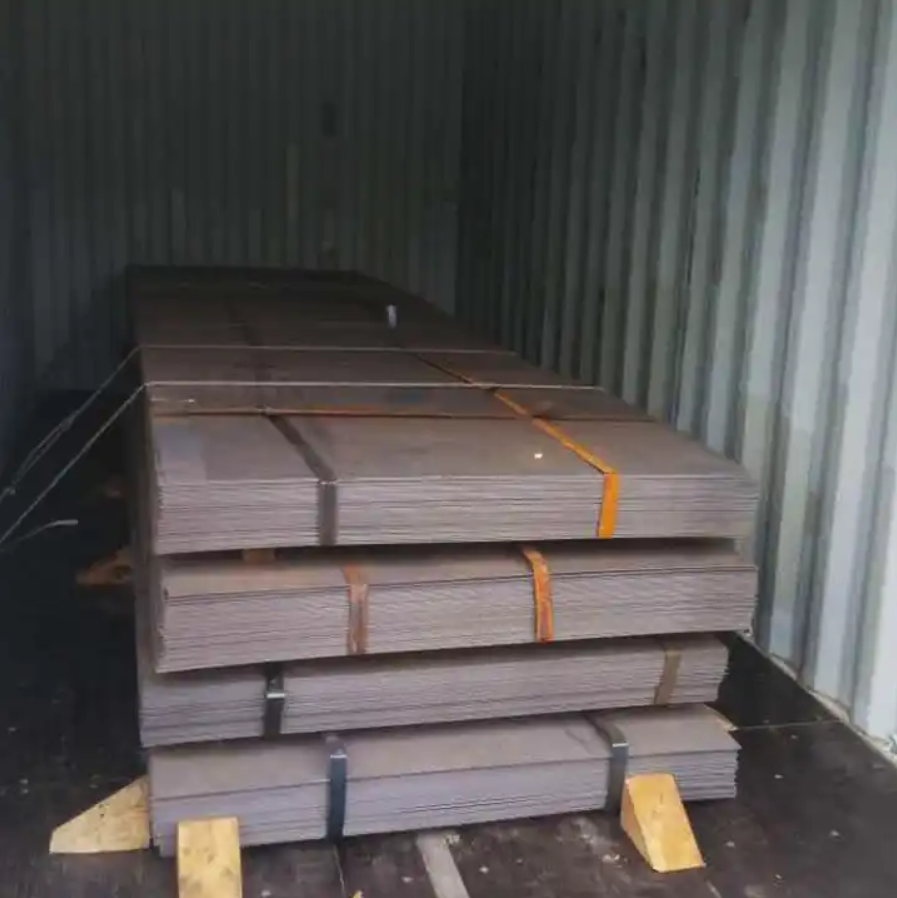
Matching the correct carbon content to your specific application prevents catastrophic failures. Carbon dictates the final hardness, tensile strength, and weldability of the steel. You must align these material properties directly with your engineering requirements.
Low carbon steel, often called mild steel, contains up to 0.30% carbon. It offers exceptionally high weldability and formability. Manufacturers use it extensively for general structural construction. It bends easily without cracking. You will find mild steel in building frames, generic base plates, and standard pipeline fittings. Its low tensile strength makes it less ideal for high-wear environments, but its ductility remains unmatched.
Medium carbon steel contains between 0.31% and 0.60% carbon. This range provides a vital balance between strength and ductility. It resists deformation under load better than mild steel. Engineers specify medium carbon grades for machinery parts, gears, and heavy equipment components. It requires more care during welding. You might need to apply pre-heating techniques to avoid embrittlement in the heat-affected zone.
High carbon steel plates contain between 0.61% and 1.50% carbon. This material boasts extreme hardness. You use high carbon steel exclusively for high-wear environments. Typical applications include mining equipment, cutting edges, and industrial plow blades. However, this hardness brings severe brittleness. You face mandatory pre-heating and specialized welding procedures to prevent cracking. Machining high carbon steel also takes significantly more time and requires specialized tooling.
Outcome mapping connects your carbon grade choices to specific business outcomes. You must prioritize load-bearing longevity versus ease of secondary fabrication.
Carbon Category | Carbon % Range | Key Property | Primary Business Outcome |
|---|---|---|---|
Low Carbon (Mild) | 0.05% - 0.30% | High Weldability & Ductility | Rapid fabrication, low assembly risk |
Medium Carbon | 0.31% - 0.60% | Balanced Strength & Wear | Machinery longevity, moderate load bearing |
High Carbon | 0.61% - 1.50% | Extreme Hardness | Maximum abrasion resistance, tool-grade durability |
Choosing the wrong carbon matrix leads to rapid part degradation or excessive fabrication delays. Always verify the carbon percentage before finalizing your factory order.
Sourcing metal from multiple fragmented suppliers introduces massive logistical risks. Delays from one vendor can stall an entire construction timeline. We strongly recommend leveraging the single-source advantage. Utilizing a factory capable of bundled structural supply reduces multiple-vendor lead time risks. You simplify communication, streamline quality assurance, and often negotiate better freight rates. A unified supply chain guarantees consistent material traceability across your entire bill of materials.
Consider the structural framing integration required for heavy industrial frameworks. Load-bearing construction rarely relies on plates alone. You need supporting members to distribute weight effectively. Consolidating your procurement means sourcing heavy plates alongside H Beam Steel to form rigid primary columns. You then connect these primary columns using Steel Angle Bar for cross-bracing and secondary support. Purchasing these structural profiles from the same facility ensures matching metallurgical standards. It also guarantees seamless assembly geometry once the materials reach your job site.
Procurement integration extends beyond the core skeleton. Modern industrial projects require environmental and architectural additions. You must address fluid transport and exterior protection simultaneously. We advise sourcing corrosion-resistant materials directly from the same supply chain node. For exposed fluid and gas transport systems, you can secure Galvanized Steel Pipe. Its zinc coating provides excellent defense against harsh weather. Similarly, your facility will need exterior cladding or roofing. You can bundle PPGI Steel Coil (Pre-Painted Galvanized Iron) into your master order. This provides immediate aesthetic and environmental protection for the building envelope.
Cross-sourcing these complementary components eliminates compatibility blind spots. It prevents situations where structural frames arrive weeks before the necessary pipe networks or roofing coils. A capable factory coordinates the production and dispatch of all these elements simultaneously.
Evaluating a metal factory demands strict due diligence. You cannot rely on marketing claims alone. You need documented proof of material performance and processing competence. A supplier's internal quality control directly impacts your structural safety.
First, you must demand verifiable quality control documents. Mill Test Reports (MTRs) are non-negotiable. An MTR provides certified proof of the metal's chemical composition and physical properties. It verifies the exact carbon, manganese, and sulfur content. It also records the yield strength, tensile strength, and elongation percentage. Without an MTR, you cannot legally verify material compliance for heavy structural projects. Never accept materials from a factory refusing to supply batch-specific MTRs.
Second, evaluate their internal defect mitigation strategies. Thicker plates naturally carry higher risks of internal flaws. During the continuous casting and hot rolling phases, non-metallic inclusions or laminations can form beneath the surface. You cannot see these defects with the naked eye. We recommend prioritizing factories equipped with ultrasonic testing (UT) capabilities. UT uses high-frequency sound waves to detect sub-surface laminations. It ensures the internal integrity of the plate remains uncompromised before it leaves the mill.
You must rigorously assess the supplier's value-add processing capabilities. Buying raw master plates often requires expensive secondary machining at your facility. A top-tier factory offers in-house precision cutting. Evaluate their specific processing tools:
Precision Plasma Cutting: Ideal for mid-thickness plates, offering fast cut speeds and relatively clean edges.
Laser Cutting: Essential for thin-to-medium materials requiring exceptional dimensional accuracy and tight tolerances.
Oxy-Fuel Cutting: Necessary for exceptionally thick carbon plates (often over 2 inches), where laser and plasma become ineffective.
Press Braking and Bending: Useful if you need the plate pre-formed into specific angles before shipping.
Utilizing a supplier's value-add processing reduces your scrap rates significantly. It eliminates the need to transport excess material weight, cutting down your freight overhead. It also accelerates your assembly timeline, as parts arrive ready for immediate welding.
Procuring heavy industrial metals involves massive logistical hurdles. A factory might produce excellent steel, but poor logistics will ruin the project budget. You must master freight management, surface preparation, and delivery risk.
Consider freight and weight density first. Heavy plates possess immense weight density, frequently maxing out truck load limits before filling the trailer's physical volume. You must frame the logistical constraints carefully. Assess the supplier's proximity to major shipping routes. Determine if they have direct rail access inside their facility. Rail transport drastically reduces long-haul freight expenses for large volume orders. Verify their flatbed loading capabilities. They must possess heavy-duty overhead cranes to load trucks safely and balance the axle weights properly. Improper loading leads to transit delays and DOT fines.
Next, establish clear expectations for mill scale management. The hot rolling process inherently leaves a layer of dark, flaky iron oxide on the metal's surface. You cannot paint or coat directly over mill scale. It will eventually flake off, taking your expensive industrial coatings with it. You must perform abrasive blasting (such as sandblasting to SSPC standards) or chemical pickling to remove this scale. You need to clarify whether the factory provides inline blasting services or if you must handle surface preparation independently.
Finally, utilize a strict shortlisting logic to finalize your vendor selection. Reviewing their commercial terms protects you from operational disruptions. Use the following checklist to evaluate their logistical flexibility:
Minimum Order Quantities (MOQs): Verify if their MOQs align with your actual project needs, avoiding forced over-purchasing.
Delivery Schedule Flexibility: Check if they support just-in-time (JIT) delivery to prevent job site clutter.
Claims-Handling Policies: Demand a written policy detailing how they handle out-of-tolerance deliveries or transit damage.
Traceability Systems: Ensure they physically stamp heat numbers on every plate for field verification.
Addressing these implementation realities transforms a risky procurement process into a predictable, manageable supply chain operation.
Selecting a reliable hot-rolled plate supplier hinges on verifiable metallurgical data, secondary processing capabilities, and logistical transparency. You cannot afford to treat structural steel as a simple commodity. You must scrutinize the factory's ability to provide certified MTRs and conduct internal defect testing. Bundling complementary materials like structural framing and coated coils further secures your supply chain against disruption.
Take immediate action to safeguard your next project. Advise your procurement team to request sample MTRs from prospective factories immediately. You should clarify exact gauge-to-inch tolerances in all upcoming RFQs to eliminate dimensional guesswork. Finally, audit your shortlisted suppliers' capacity for bundled structural orders before finalizing any long-term contract. Proactive diligence ensures your materials arrive on time, precisely within spec, and ready for fabrication.
A: Standard tolerances fall under ASTM A6 guidelines. These regulate acceptable variations in thickness, width, length, and flatness. Hot rolling inherently produces wider dimensional variance than cold rolling due to thermal contraction. You must account for these looser tolerances during the structural design phase to avoid assembly misalignment.
A: Reputable factories use optical emission spectrometry to confirm the exact chemical composition (carbon, manganese, etc.). They also conduct physical tensile testing to measure yield and tensile strength. They compile this data into a certified Mill Test Report (MTR), proving the metal matches the requested ASTM standard.
A: Raw carbon steel oxidizes rapidly when exposed to moisture and oxygen. It cannot survive outdoors untreated. You must apply secondary surface treatments. Common protection methods include hot-dip galvanizing, zinc-rich primers, or heavy-duty industrial polyurethane coatings to ensure long-term weather resistance.
A: Factories usually ship standard master plates (e.g., 4x8 or 8x20 feet) directly from inventory within days. Custom-cut profiles require programming, specialized plasma or laser processing, and individual part handling. This secondary processing typically extends fulfillment windows by two to four weeks depending on factory backlog.